Optimising Osmolality in the Geri® Dish: Why Volume and Design Matter
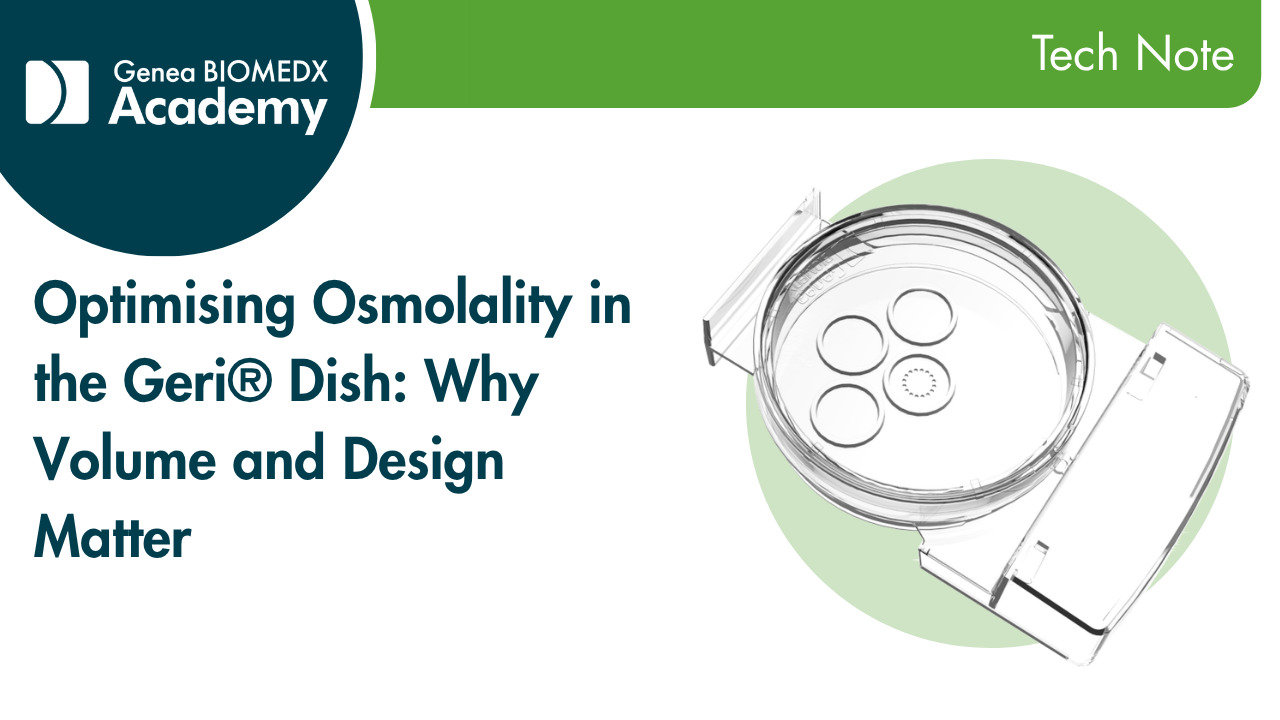
Discover how precise media and oil volumes in optimized dishes provide superior osmolality control than humidification alone.
Achieving Optimal Osmolality Control in Embryo Culture
Inadequate control of media osmolality poses a serious risk to embryo development, particularly in monophasic culture systems where embryos remain without medium replenishment for extended periods. While humidified incubators have traditionally been viewed as the primary defense against evaporation, recent evidence reveals that media and oil volumes, combined with culture dish design, exert a far greater influence on osmolality stability than humidification alone. This paradigm shift empowers embryologists to take direct, measurable control of the culture environment through strategic parameter optimization.
The role of Humidification for Osmolality Control in Embryo Culture
Contrary to popular opinion, simply introducing humidity does not guarantee protection against osmotic stress. Studies monitoring culture conditions over 136 hours demonstrated that configurations using less than 4.5 mL of oil and/or 60 µL media drops resulted in osmolality increases of at least 15 mOsm/kg, regardless of humidification status. This finding underscores that relying solely on incubator humidity is insufficient; precise control of fluid volumes remains the critical factor in preventing harmful evaporation.
The Power of Optimized Configuration
When optimal parameters are applied, the results are transformative. Using 80 µL media drops overlaid with 4 mL of mineral oil in a Geri® dish limited osmolality increases to aprox. 8 mOsm/kg over the full culture period, whether in dry or humidified environments. This configuration provides a crucial safety net against unavoidable variability in dish preparation and potential loss of humidity, ensuring consistent protection for developing embryos.
Why Dish Architecture Matters for Osmolality Control
The physical design of the culture dish proves equally imperative. The Geri® dish, featuring 16 micro-wells within the central well, dramatically reduces the surface area of media in contact with oil compared to traditional formats. In contrast, even when maximally overlaid with 11 mL of oil, medium drops in standard 60 mm Falcon dishes exhibited osmolality increases exceeding 25.8 mOsm/kg, more than double the Geri® dish. This evidence confirms that selecting an optimised dish is not optional but essential for reducing osmotic risk.
*This is a reedition of a 2018 document
What You Will Learn
- Beyond Humidification: Why media and oil volumes have a greater impact on osmolality control than simply using a humidified incubator.
- The Gold Standard Configuration: How using 80 µL drops with 4 mL oil overlay maintains osmolality changes below 10 mOsm/kg.
- The Micro-well Advantage: Why the Geri® dish design minimizes evaporation risk far more effectively than standard 60 mm Falcon dishes.
- Actionable Best Practices: Evidence-based recommendations to eliminate osmotic stress and provide optimal culture conditions for embryo development.
Related Articles
-
Transforming Embryo Culture: Insights and Innovations with the GERI Incubator
Discover how Time-Lapse incubation is transforming embryo culture, helping IVF labs make smarter decisions, optimise workflows, and improve clinical outcomes.
-
Beyond Morphology: From Gamete Metabolism to AI-Enabled Embryo Assessment
Discover how label-free metabolic imaging and artificial intelligence guide embryologists to objective viability insights and standardise embryo ranking.
-

Trehalose-Based Vitrification
Expert insights into next-generation cryopreservation strategies for the modern IVF laboratory